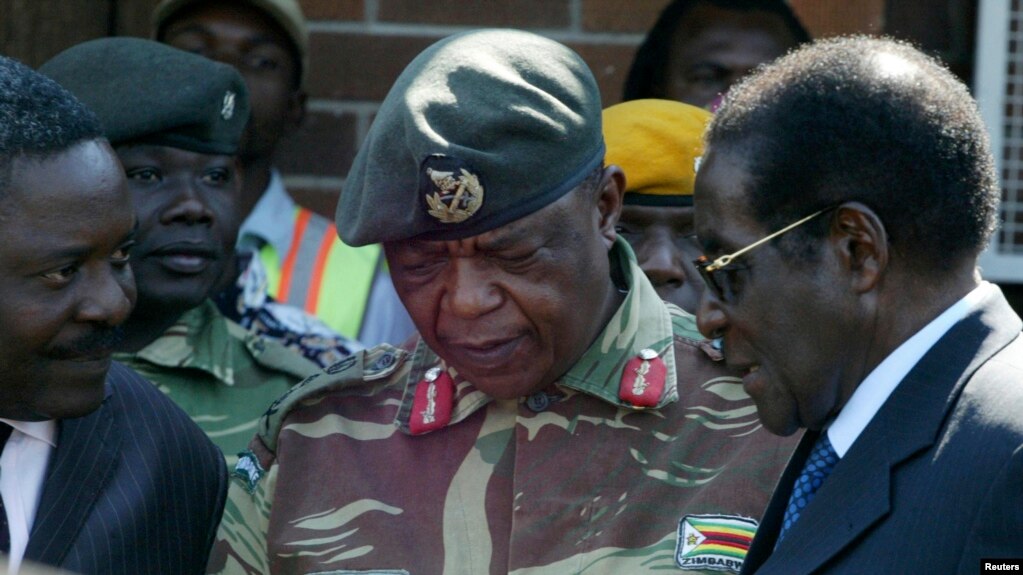
Zimbabwe's President Robert Mugabe, right, talks to General Constantine Chiwenga (center) - Photo copyright REUTERS
It has now been roughly three days since the Zimbabwe Defence Forces effectively took control of the government. What began as a text book example of an effective military coup now seems in danger of falling into a political quagmire as the new military leadership of Zimbabwe faces the political realities of their actions and the stubbornness of the man the Generals themselves still insist is the President of Zimbabwe. All this is occurring against a national backdrop of malnutrition, economic despondency, and a dramatic series of health crises that have been occurring for at least a decade.
With a country in such a dire state for so long, why have the generals only decided to act now? In a word; succession. Robert Mugabe is likely not long for this world, despite his stated aim to stand in the next set of presidential elections. The military is keen to see another veteran of the liberation war against Rhodesia take the throne, undoubtedly to ensure that their economic and political interests continued to be protected under any new regime.
Zimbabwe has been stalled in an economic rut since at least the turn of the century, when Robert Mugabe's land redistribution policies played a key part in sending the Zimbabwean economy into a tailspin. Already two years into an expensive war in the nearby Democratic Republic of the Congo, the euphemistically named "Fast-Track Land Reform Program" sent agricultural exports into a nose dive over the next seven years and turned the bread-basket of southern Africa into a nation with almost fifty percent population malnourishment. Despite this economic destruction, the military loyally stood by President Mugabe, undoubtedly related to the economically privileged positions enjoyed by the senior staff and their profitable involvement in a wide variety of economic activities, including diamond smuggling during the Congolese war.
Nonetheless, disgruntlement within the ranks has been brewing for a few years, and that has been largely due to the possibility of First Lady Grace Mugabe taking the presidential office after her husband's death. Since 2014, the dubiously titled Doctor Mugabe has been developing her own power base within the ZANU-PF political party, largely centred around the younger members in a faction known colloquially as 'G40'.
Grace Mugabe is suspected as being one of the key persuasive factors behind the firing of two Vice-Presidents; Joice Mujuru in December 2014, and Emmerson Mnangagwa on 6 November 2017. Both were guerrilla fighters from the liberation era and both were closely connected to the army; Mujuru being the widow of former army chief and politician Solomon Mujuru who profited personally from the 2000s-era land grab, and Mnangagwa serving in several high-level cabinet positions and chairing the Joint Operations Command security body, which brings together the senior leaders of each main military and security branch.
The firing of Mnangagwa appears to have been the final straw for a senior military command staff already worried about what the future may hold. On 13 November 2017, Chairman of the Zimbabwe Defence Forces Constantino Chiwenga held a press conference. Flanked by the majority of other senior generals, he denounced the purging of liberation war-era officials from the government and warned that the military would step into the situation if the matter was not resolved. A day later, social media reports were quickly picked up by global media outlets that soldiers and armoured personnel carriers were on the move around Harare, the capital of Zimbabwe.
In terms of the coup itself, it appears to have been a text book process. Perhaps Mugabe was not expecting the army to follow through with its threats, but the forces of General Chiwenga appear to have taken the rest of the Zimbabwean government apparatus largely by surprise.
If we follow Edward Luttwak's (1968) definition of a coup being "a small but critical segment of the state...used to displace the government from its control of the remainder", then that process occurred efficiently and with a minimal use of military assets. According to several media outlets, armoured personnel carriers and troops initially seen on the move towards Harare were reported by witnesses to have turned away from the city towards the Dzivarasekwa Barracks of the fanatically Mugabe-loyalist Presidential Guard Brigade. Since then, we have not heard a single thing from that military unit, suggesting that they were swiftly and forcibly confined to their barracks before they could make any kind of counter-coup move.
What is also crucial to note is the unity of senior staff behind this military intervention, seen in the near-universal assembly of senior officers during the press conference and reports of special forces units such as 1 Commando Battalion being involved in the rounding-up of officers from the Mugabe-loyalist Zimbabwe Republic Police. Some gunfire was reported on 14-15 November, possibly in relation to the military's efforts to capture Finance Minister and Mugabe-loyalist Ignatuis Chombo. A well-spoken military official appeared on Zimbabwean television to reassure the general public of the military's intentions, insisting that this was an action against criminal government elements surrounding the President rather than an overthrow of Mugabe. All very minimalist, and all very professional.
In another time, that would have been the end of the matter. For better or for worse, a coup and a military junta would now be in place in Zimbabwe. And yet, we see pictures of the generals sitting down with the President and a set of negotiations rapidly appearing to dissolve into a stalemate. Mugabe himself appeared today at the graduation ceremony of Zimbabwe Open University, in what some analysts are describing to be a defiant gesture to the generals to whom he is currently refusing to cede power. This is where putsch meets politics in the twenty-first century, and may indicate a dangerous time ahead for Zimbabwe.
Within the Southern African Development Community (SADC) - of which Zimbabwe is a part - there have been at least twenty coups since the middle of the twentieth century. As a part of its efforts to develop and secure the region, the SADC has a strict policy of not recognizing any government that comes to power as a result of a coup. During the Madagascar coup of 2009, the SADC suspended that country's membership and threatened economic sanctions. In 2014, the SADC was heavily involved in political mediation to resolve the Lesotho political crisis when Prime Minister Tom Thabane fled to South Africa and alleged a coup attempt against his government. SADC troops are still currently in Lesotho following the assassination of Defence Force commander Khoantle Motsomotso amid fears of another potential coup attempt.
And so the military leadership of Zimbabwe find themselves stuck in the odd position of negotiating with the man they already have under house arrest. In order to keep up the official political line that the military's actions are not technically a coup and thus avoid international & regional pariah status, the generals need to find a semi-constitutional way in which they can achieve a political transition, and that requires the cooperation of Robert Mugabe.
In conjunction with this concern is the danger of civil unrest within the country. Whilst Mugabe is not apparently as well-loved by the local population as he believes himself, there are still substantial areas of support for the man that won Zimbabwe's independence, which also in part explains the deferential behaviour of the generals. If Mugabe publicly decries the coup and calls his supporters to arms, the danger of a civil war becomes even more stark. Similarly, the longer the negotiations drag and Zimbabwe's political situation sits in limbo, the closer we get to a potential tipping point from uneasy calm to factional fighting. Already there are the beginnings of marches being planned on the streets in solidarity with one group or another, and the danger that may result from such marches turning sour gets only more likely as time passes.
The generals know this, and so does Mugabe. As negotiations continue, the dangers associated with brinkmanship get ever closer to a free-fall into civil war.